Description
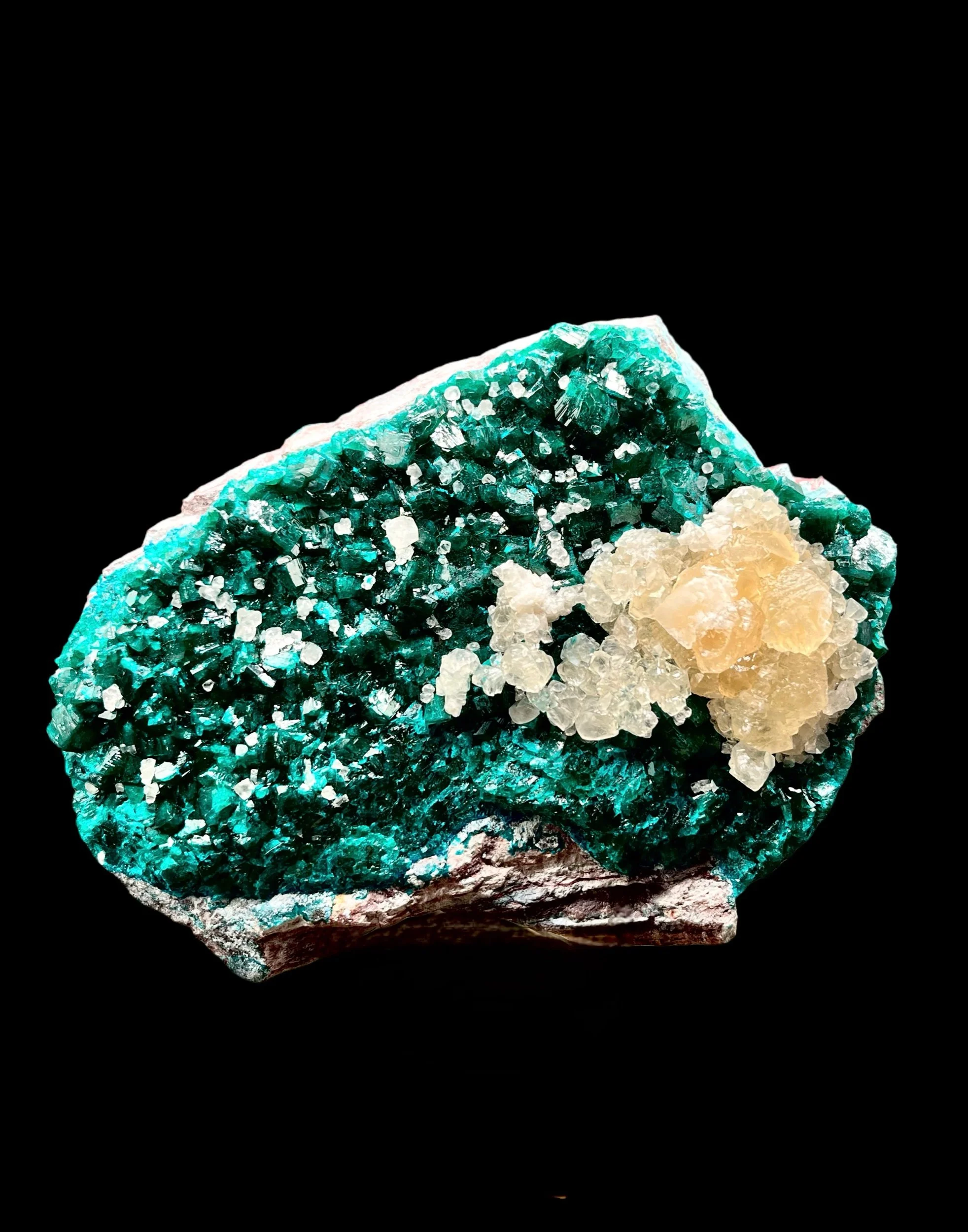
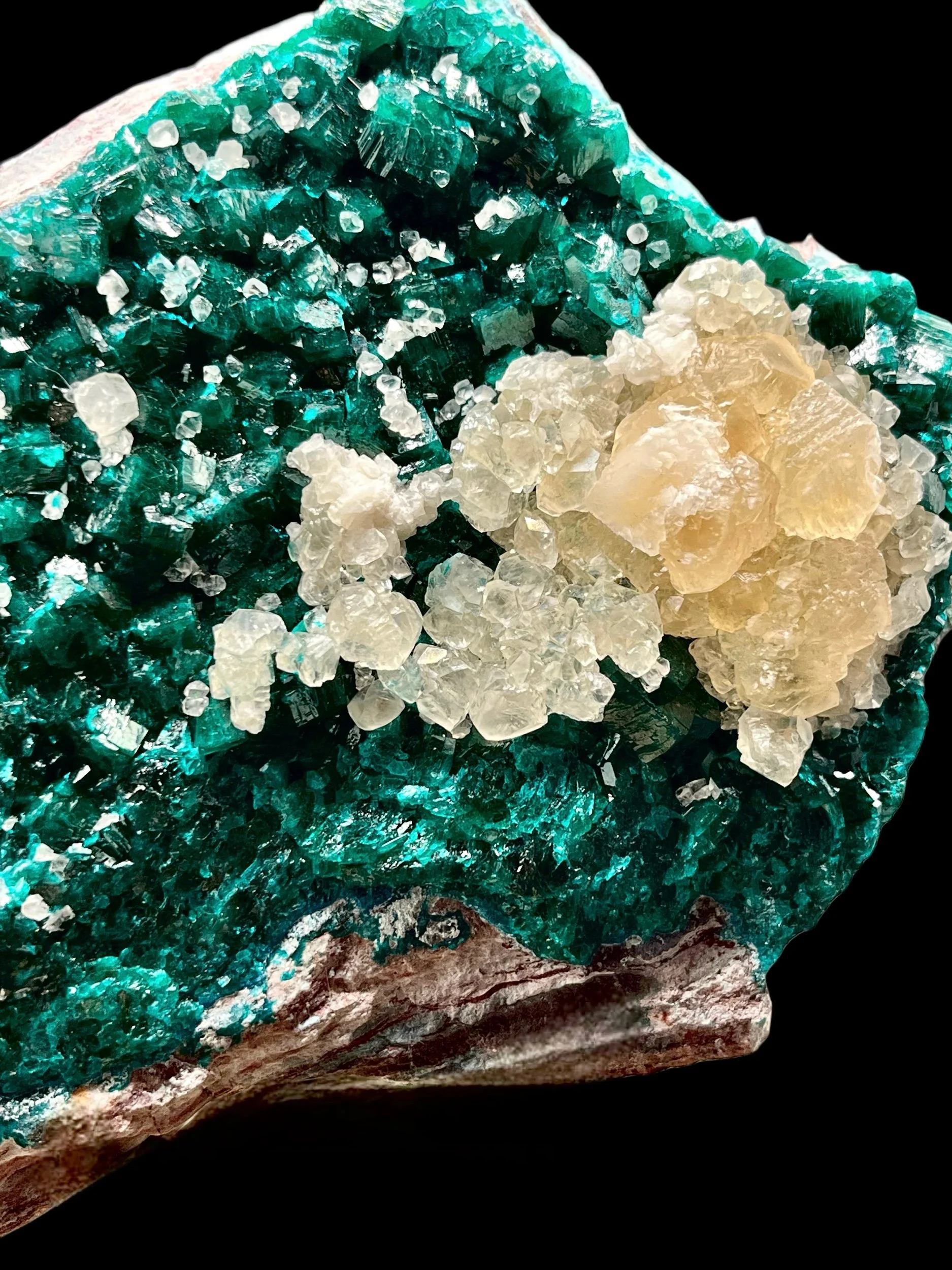
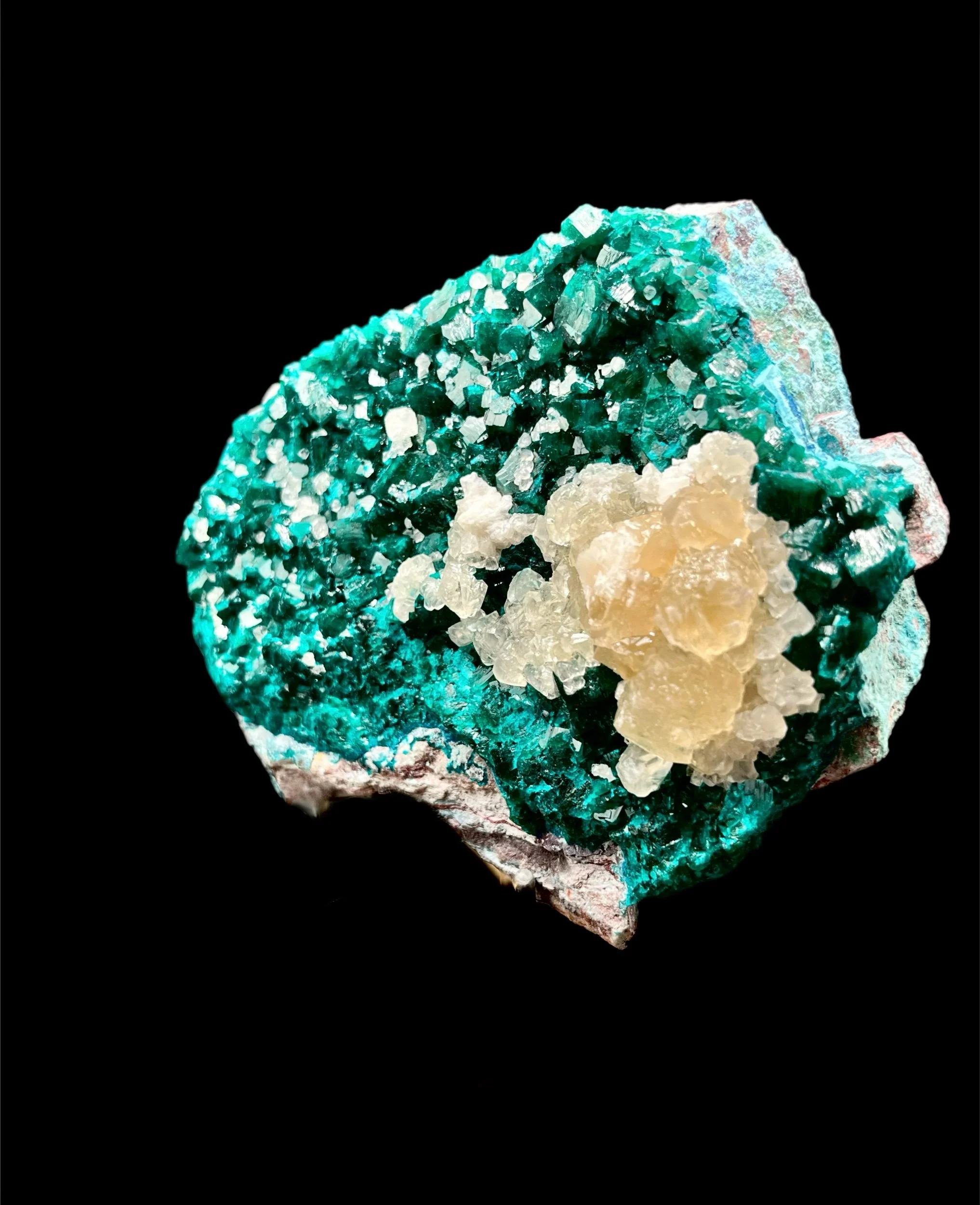
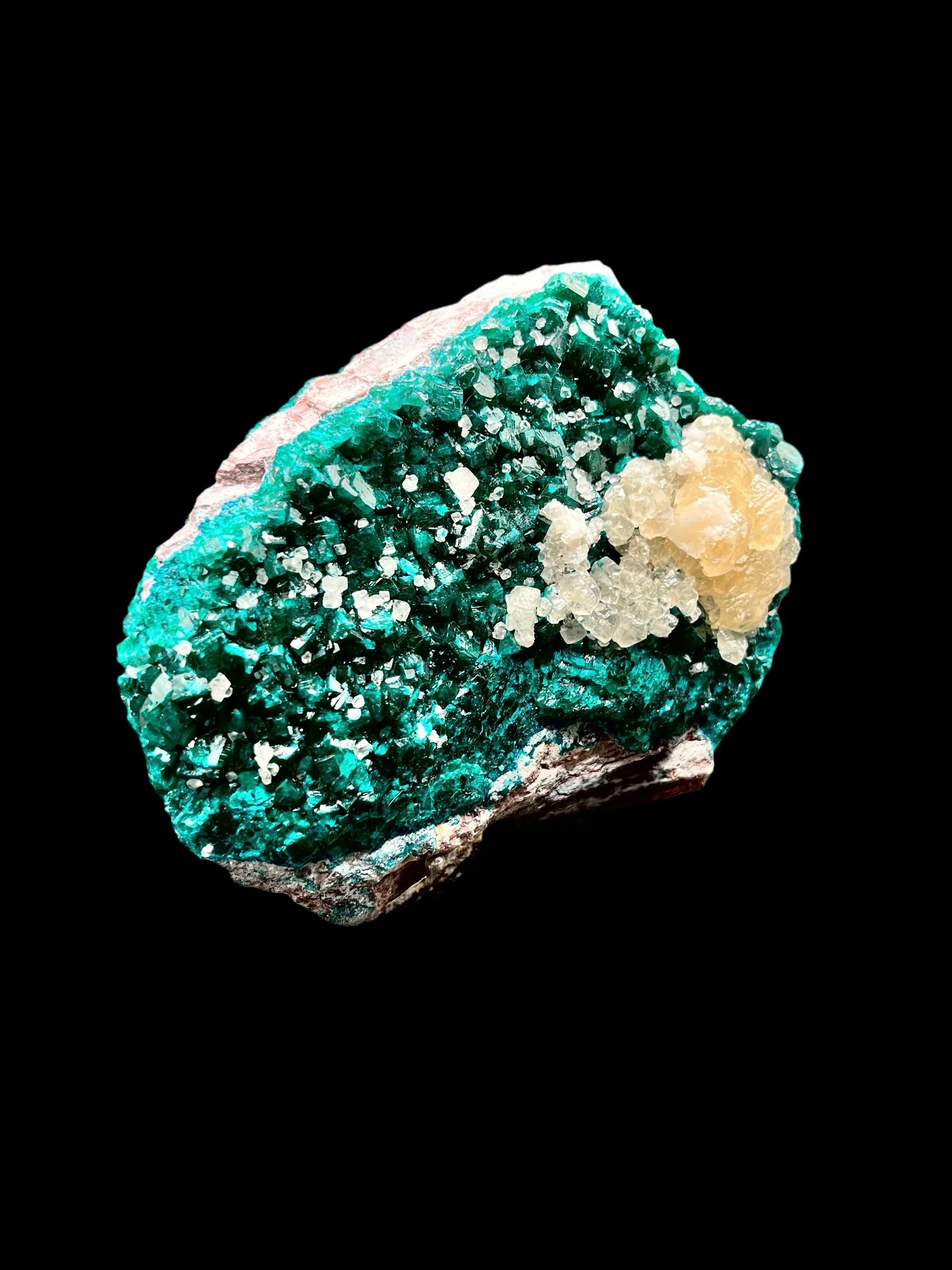
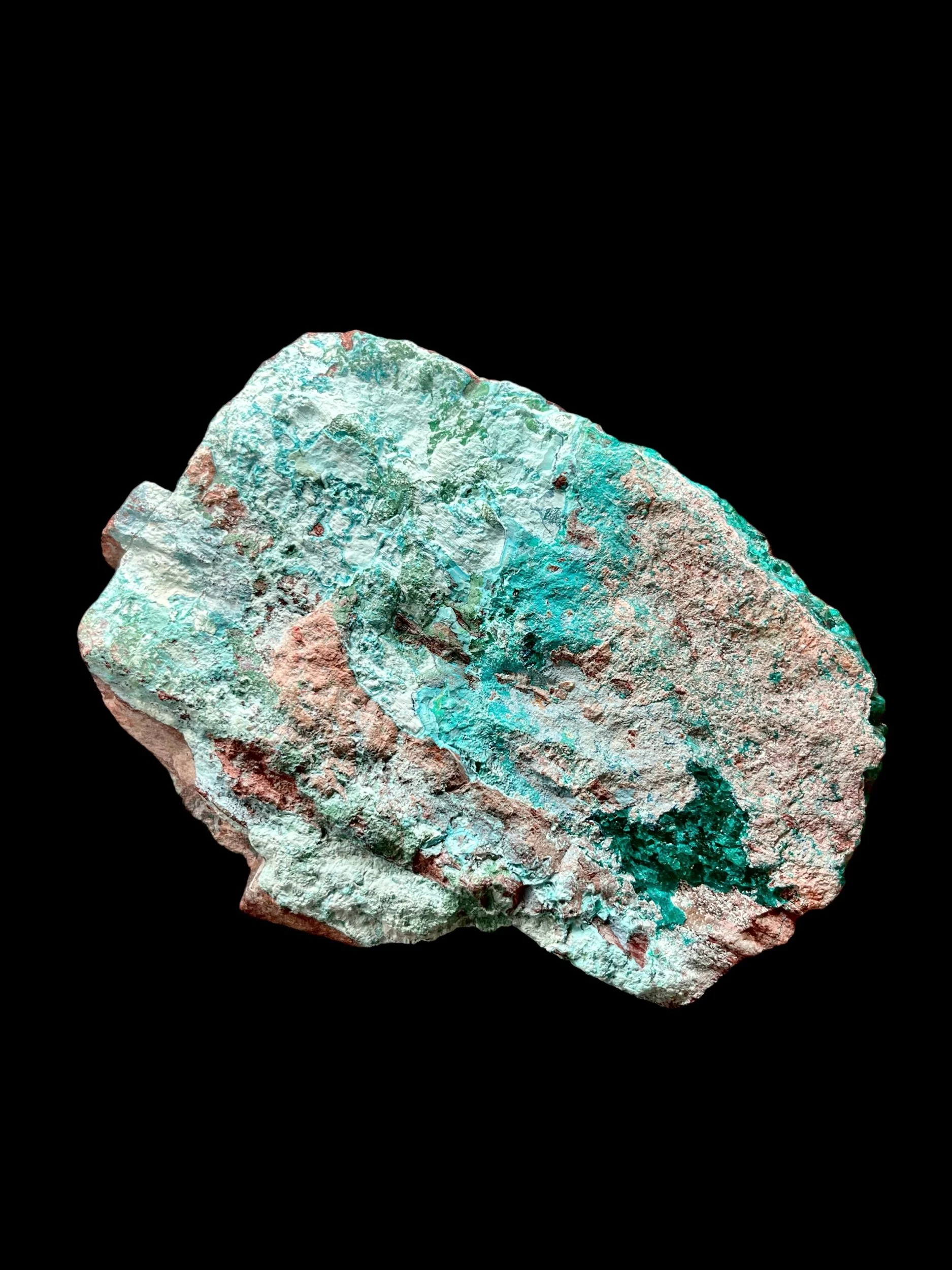
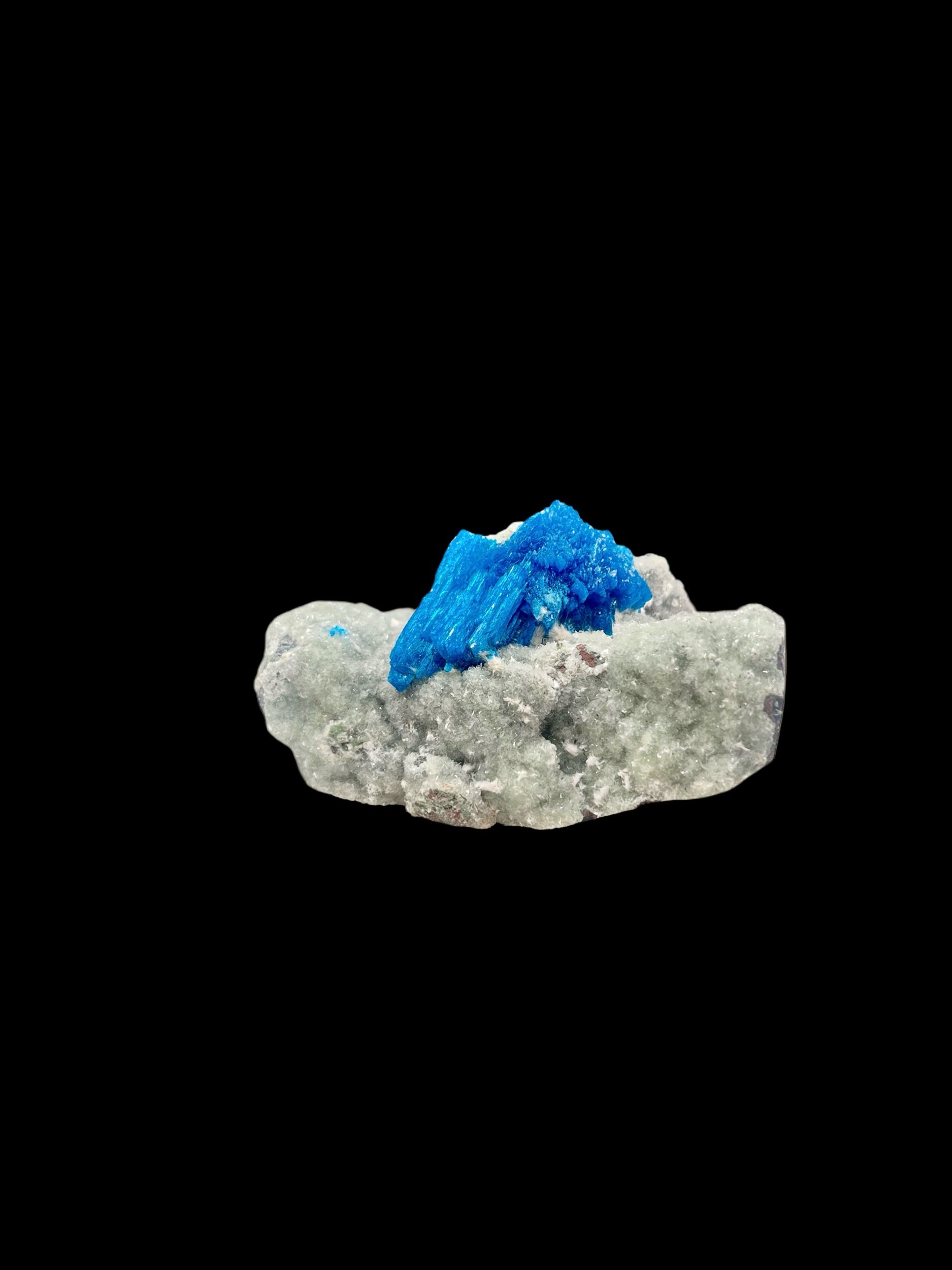
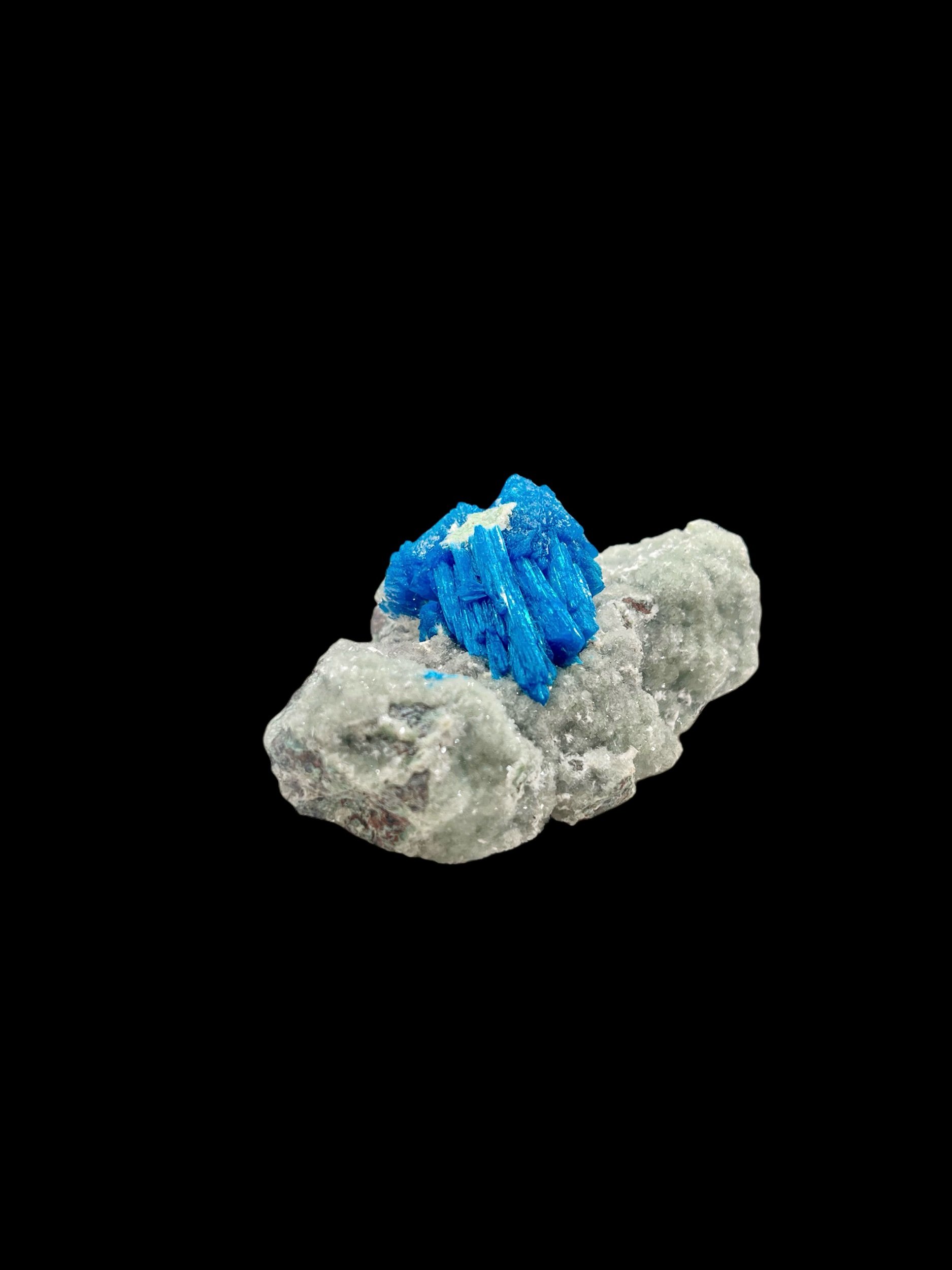
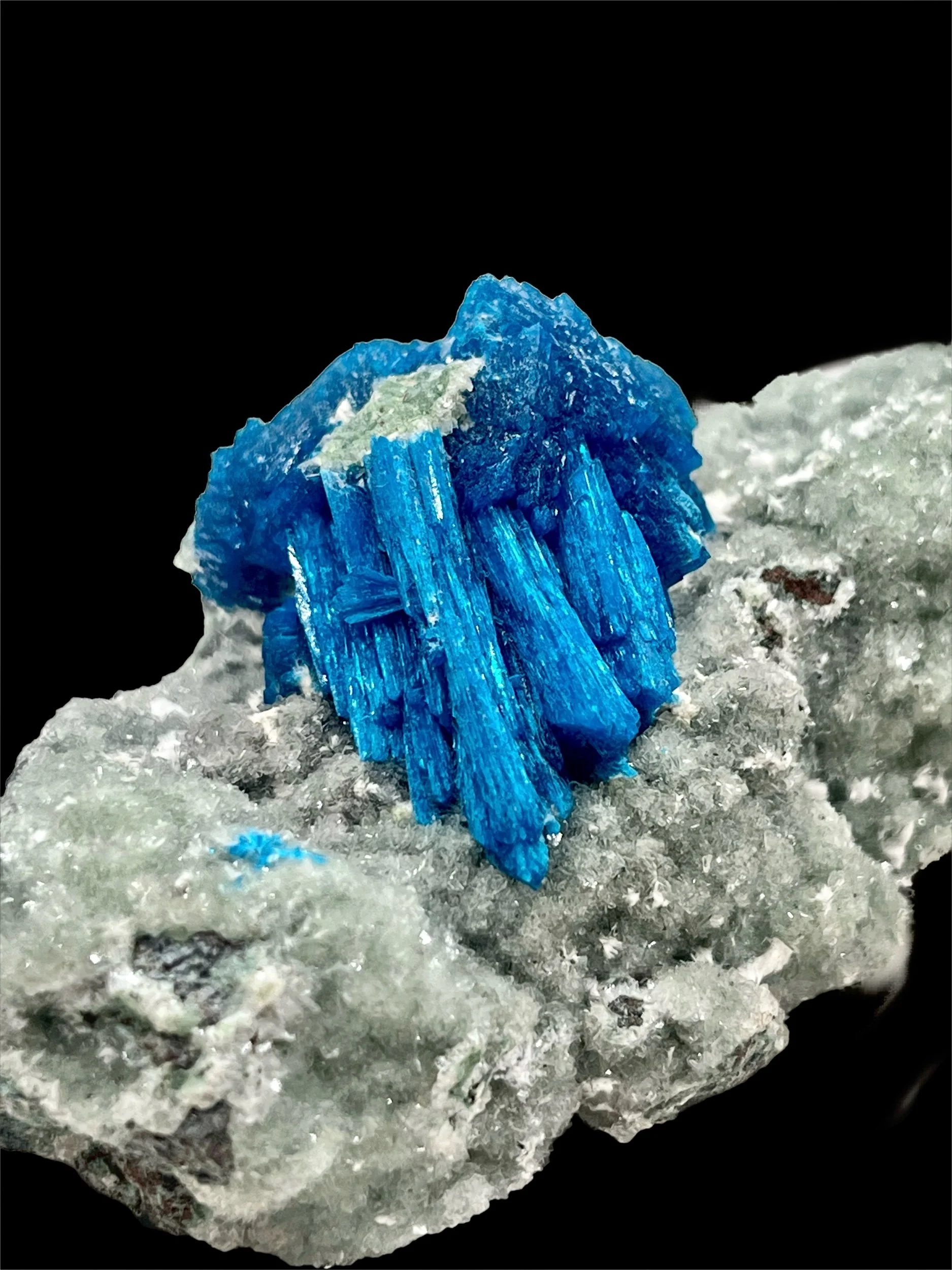
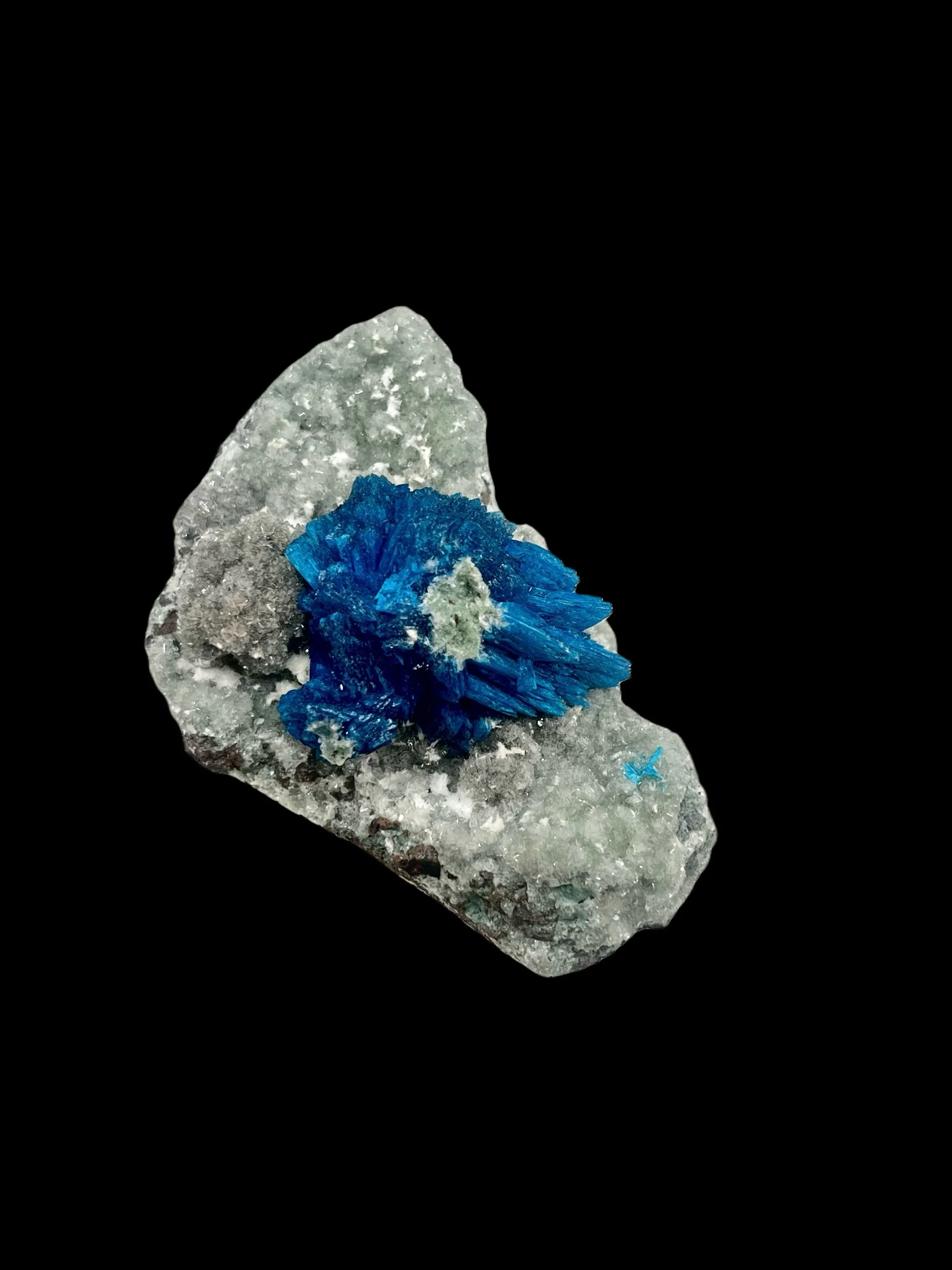
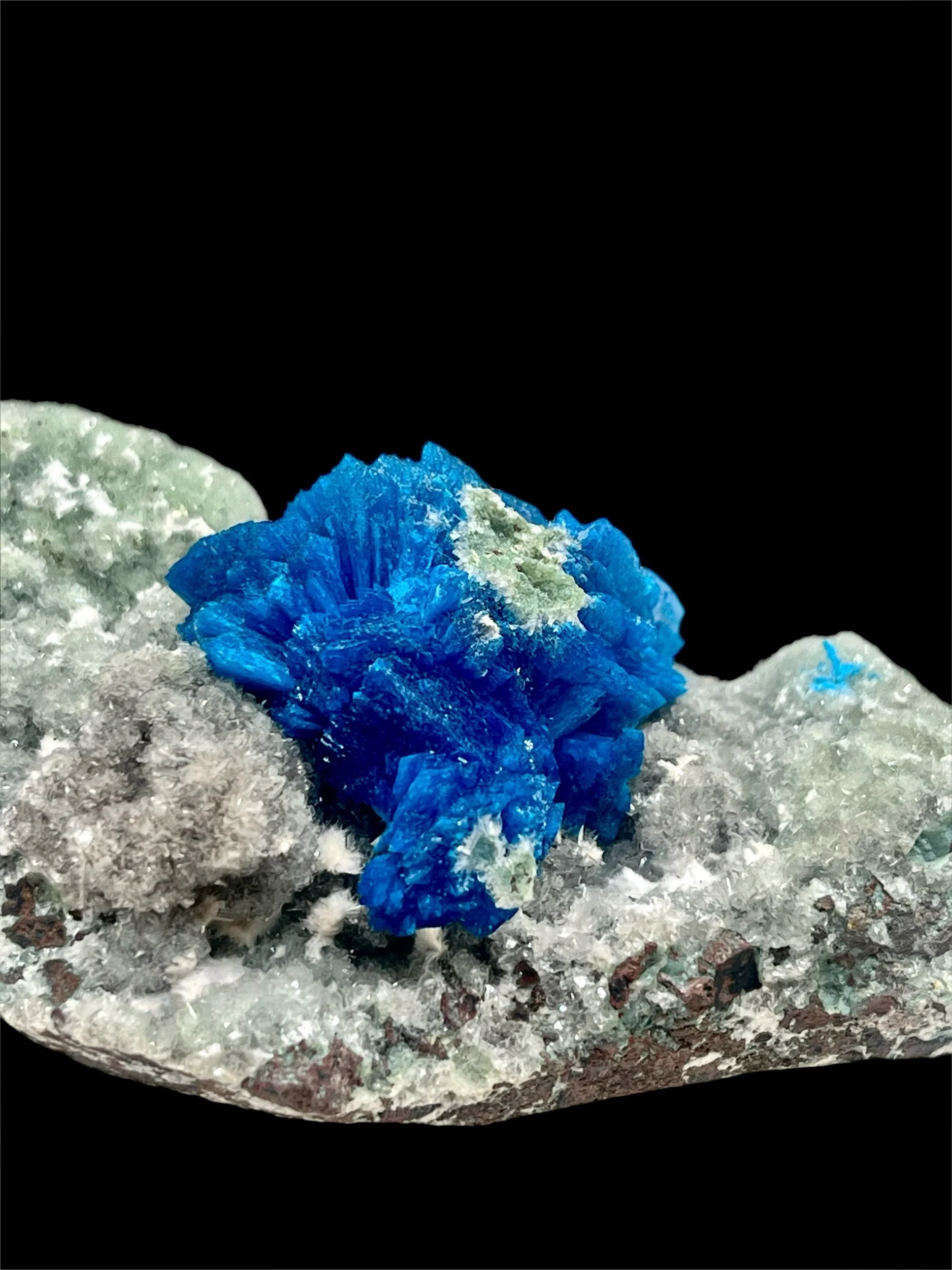
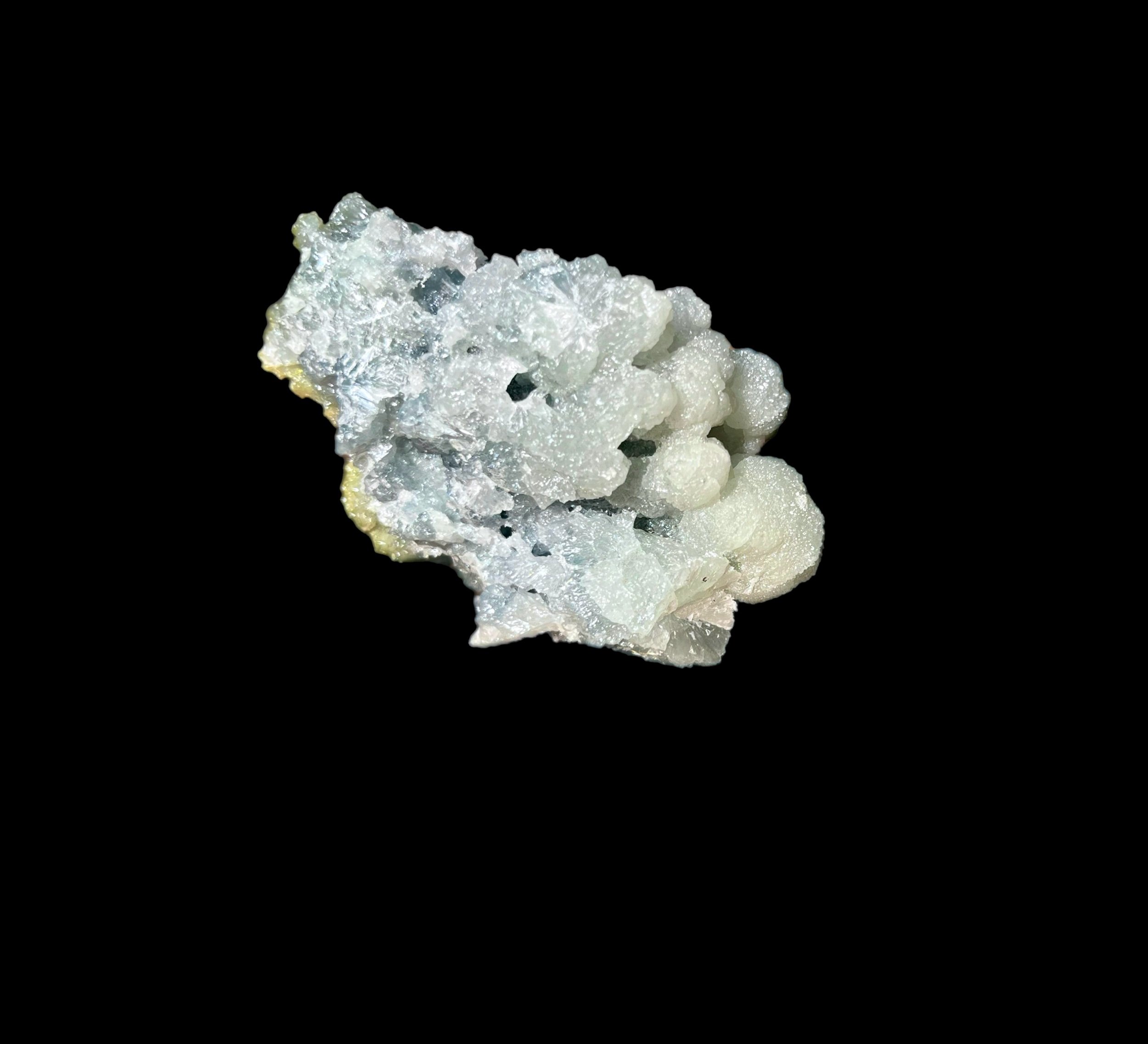
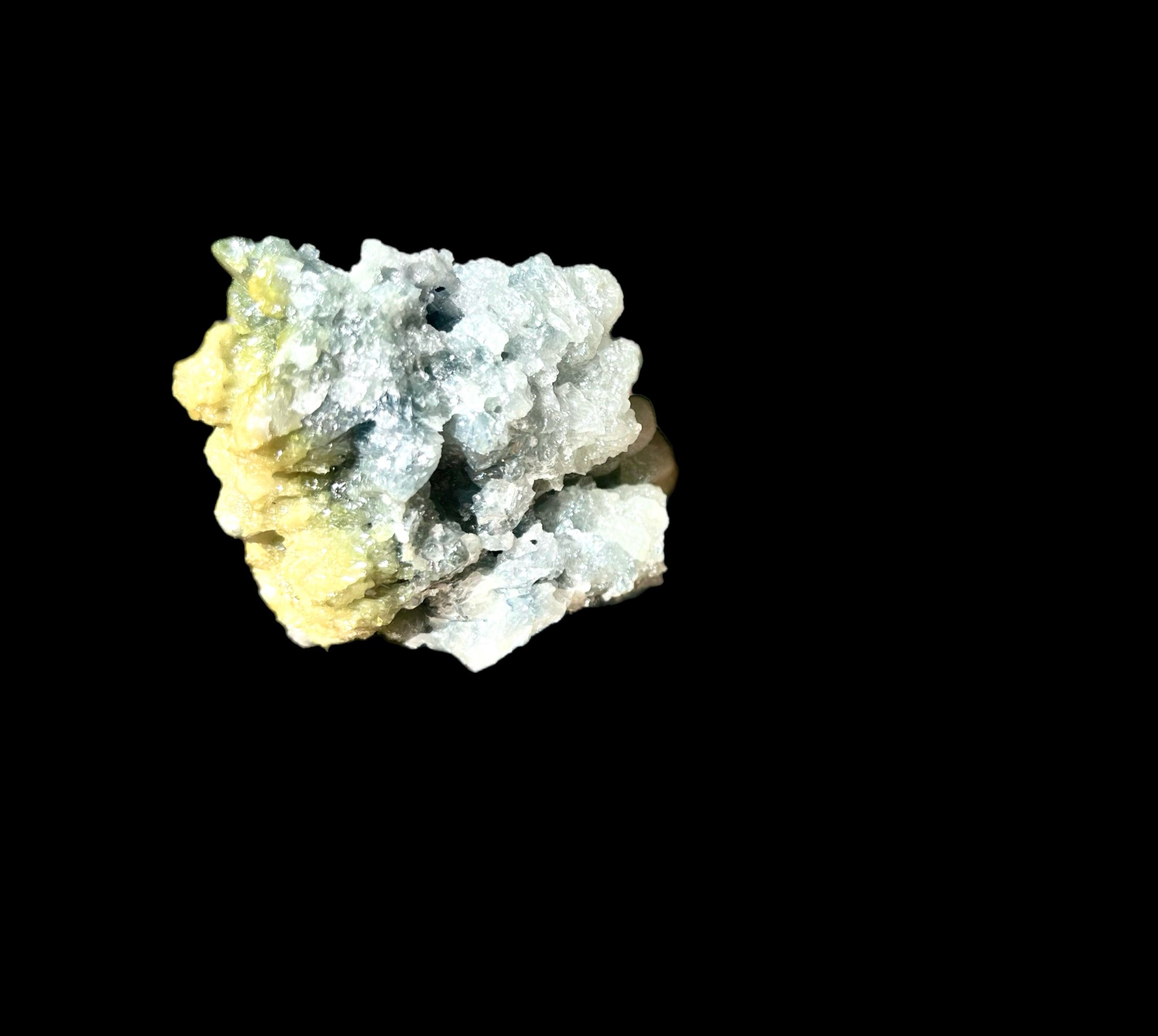
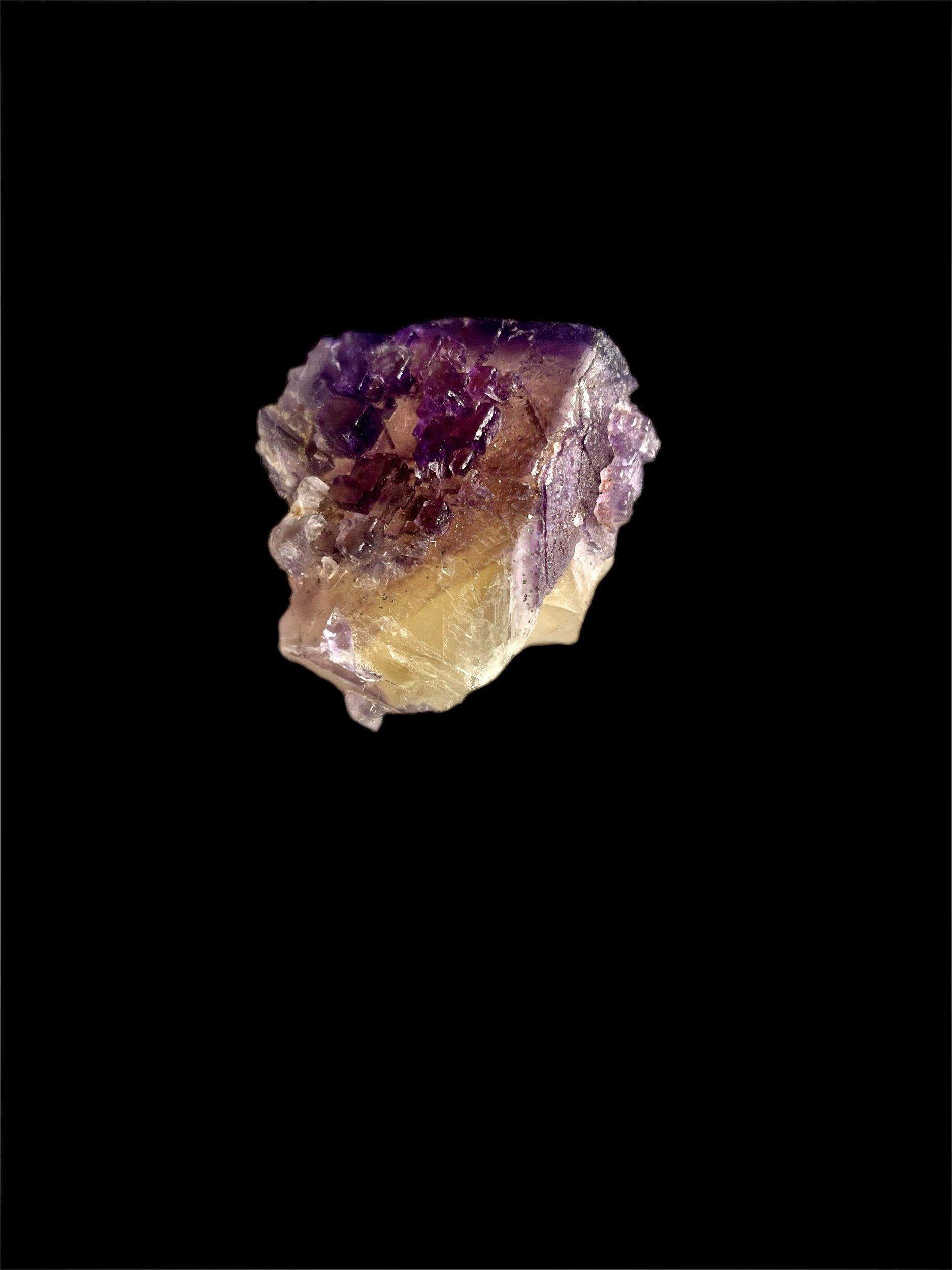
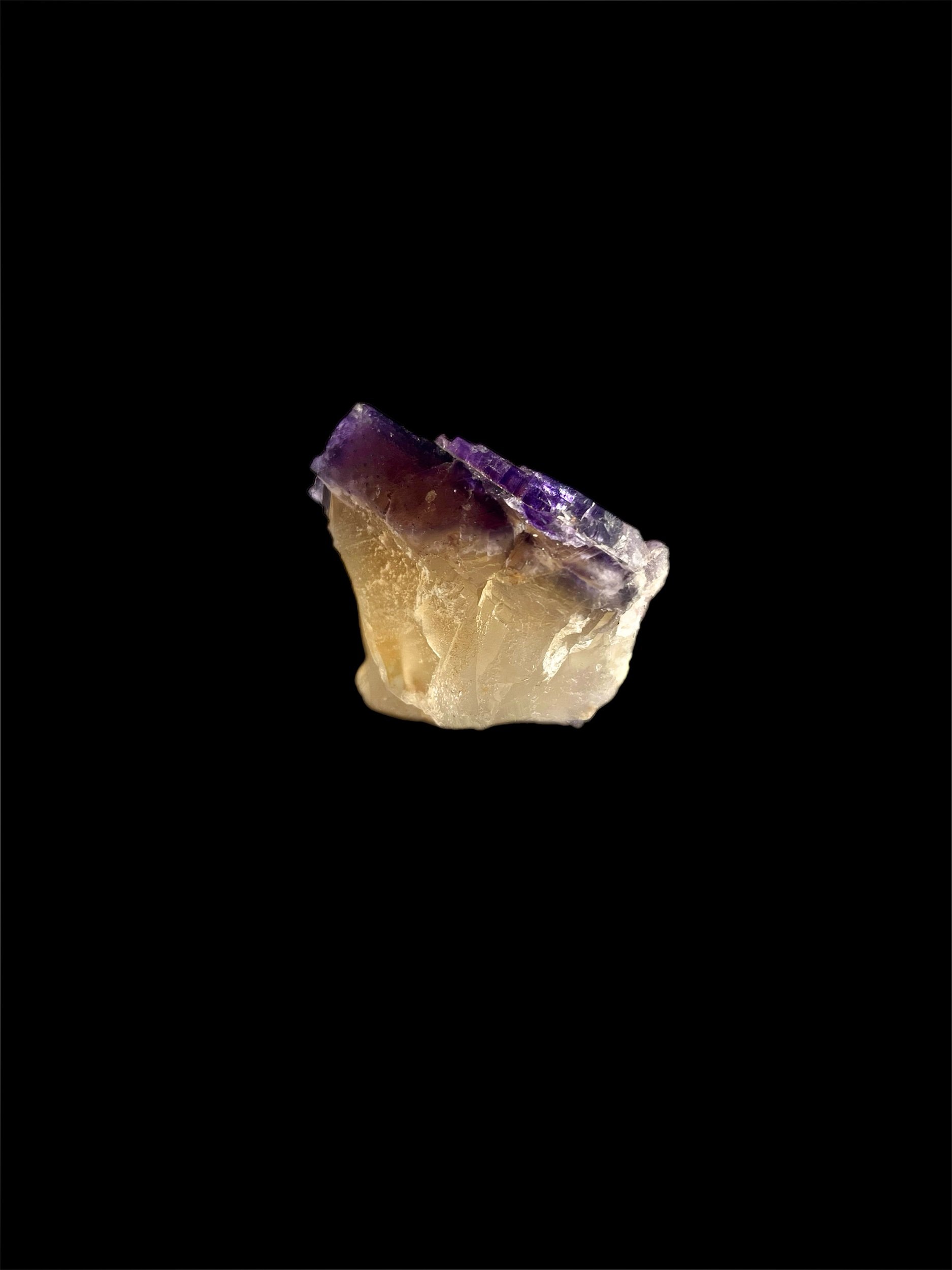
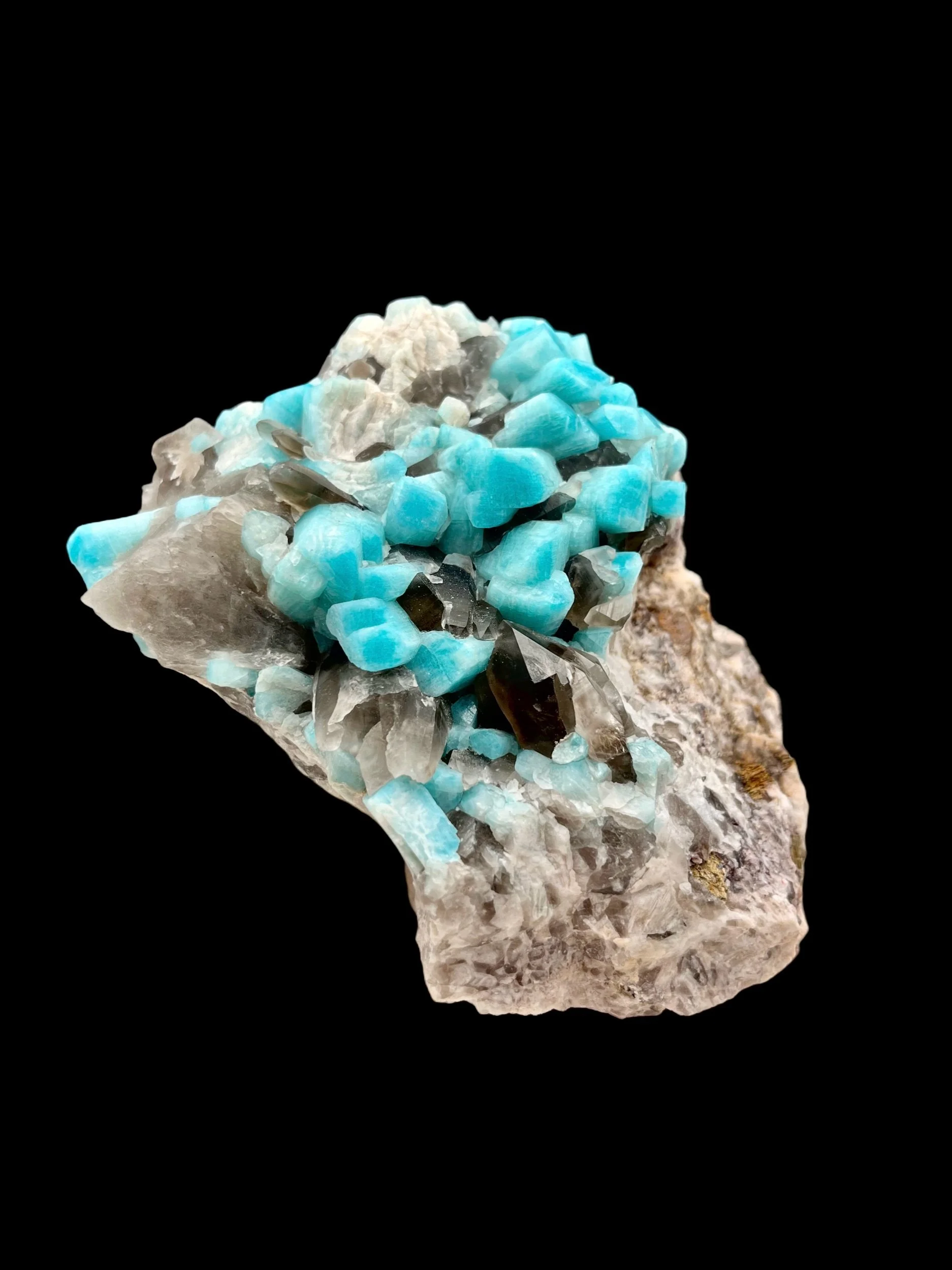
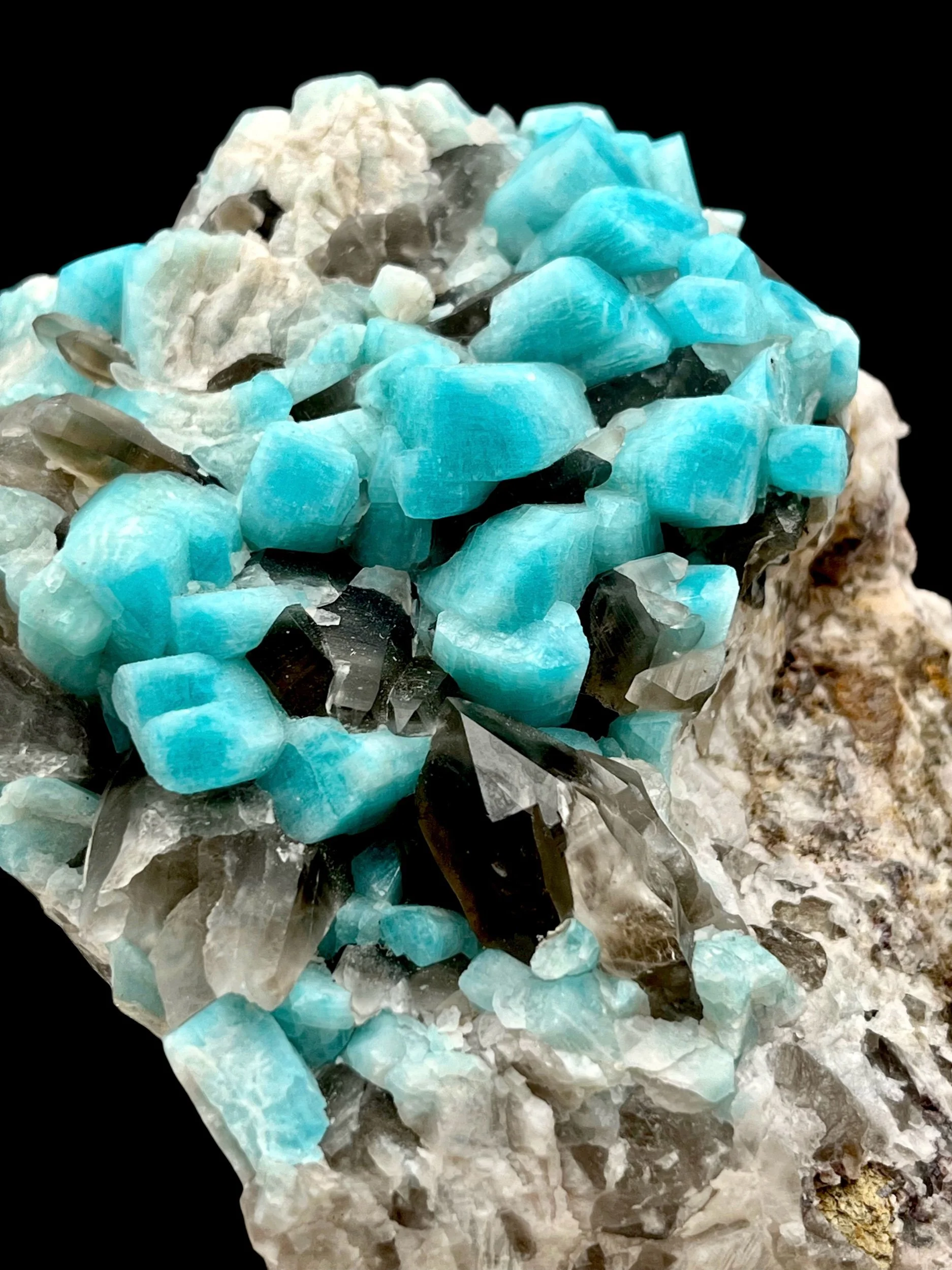
A compact and well-composed specimen featuring saturated emerald dioptase crystals accented by honey-toned calcite, with visible malachite included within portions of the calcite.
The dioptase forms a dense crystalline field across the matrix, its color deep and saturated. The crystals are sharply defined, catching light along their natural terminations.
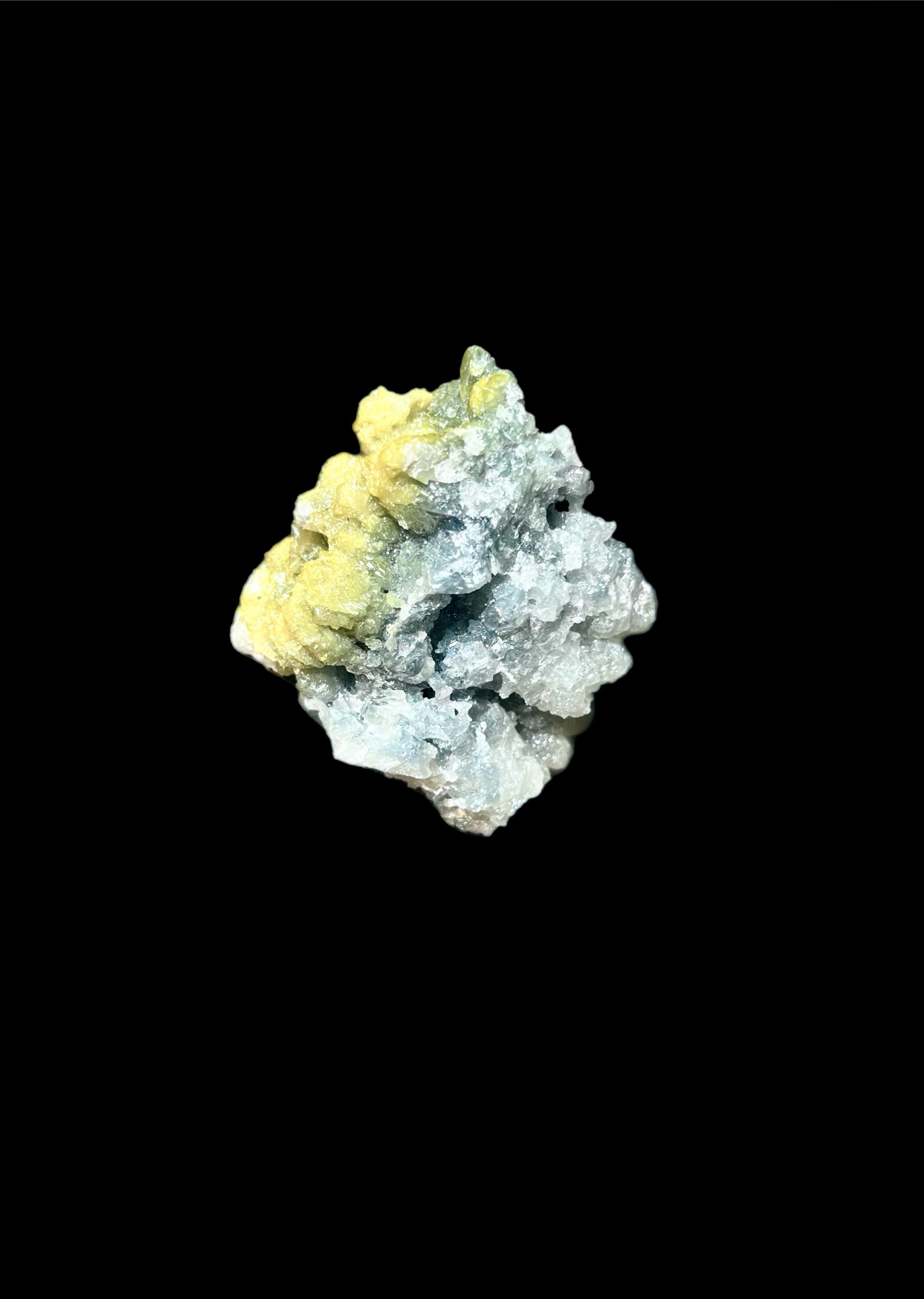
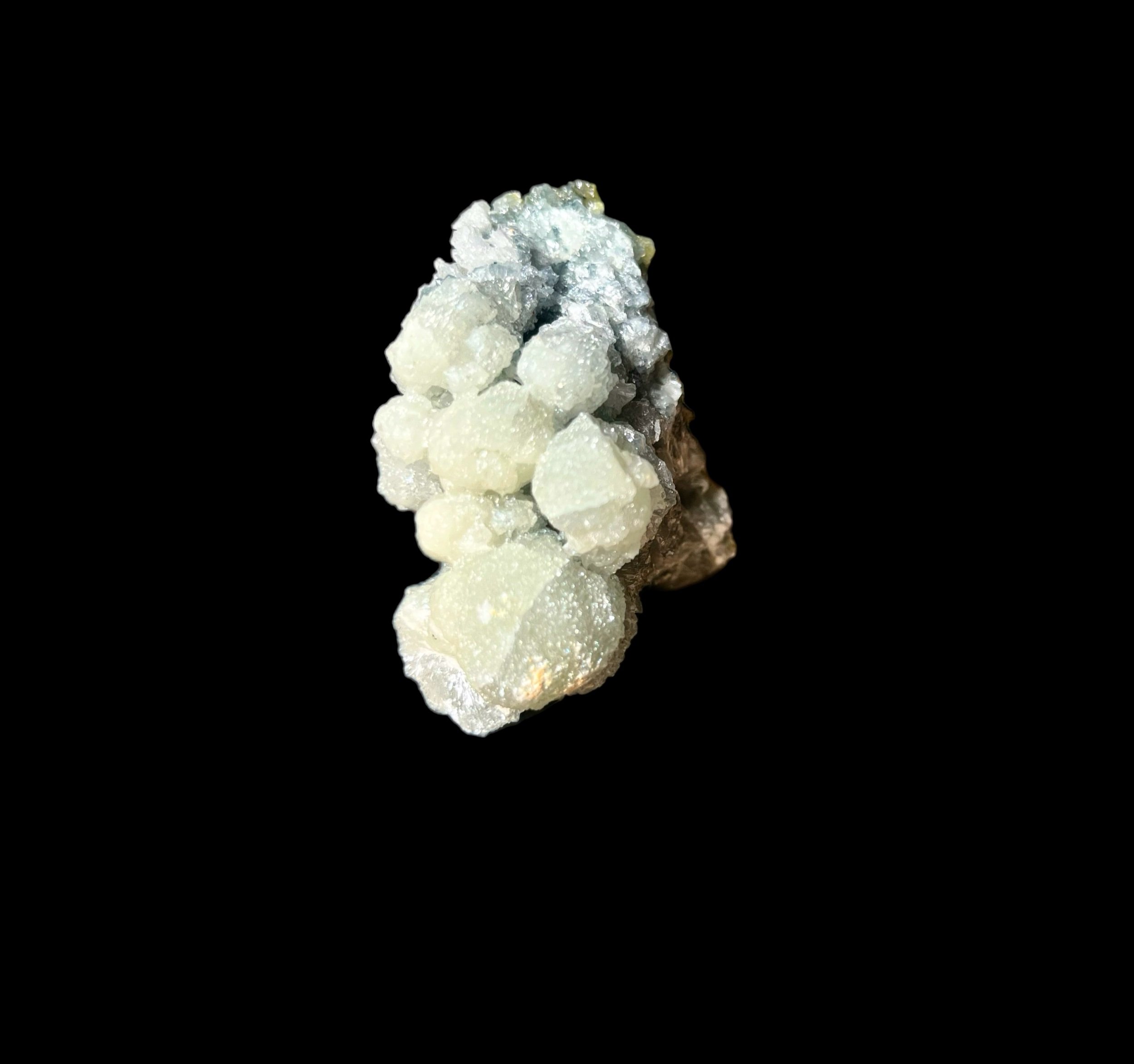
Resting across this green surface is a sculptural cluster of calcite, softly translucent and warm in tone. Within sections of the calcite, fine green malachite growth is visible — suspended inside the crystal structure. These inclusions add depth and complexity, revealing the sequential nature of mineral formation.
The contrast between the angular dioptase and the rounded calcite creates balance, while the internal malachite detail invites closer inspection.
This is specimen is layered with mineralogical interest.
Dimensions & Weight
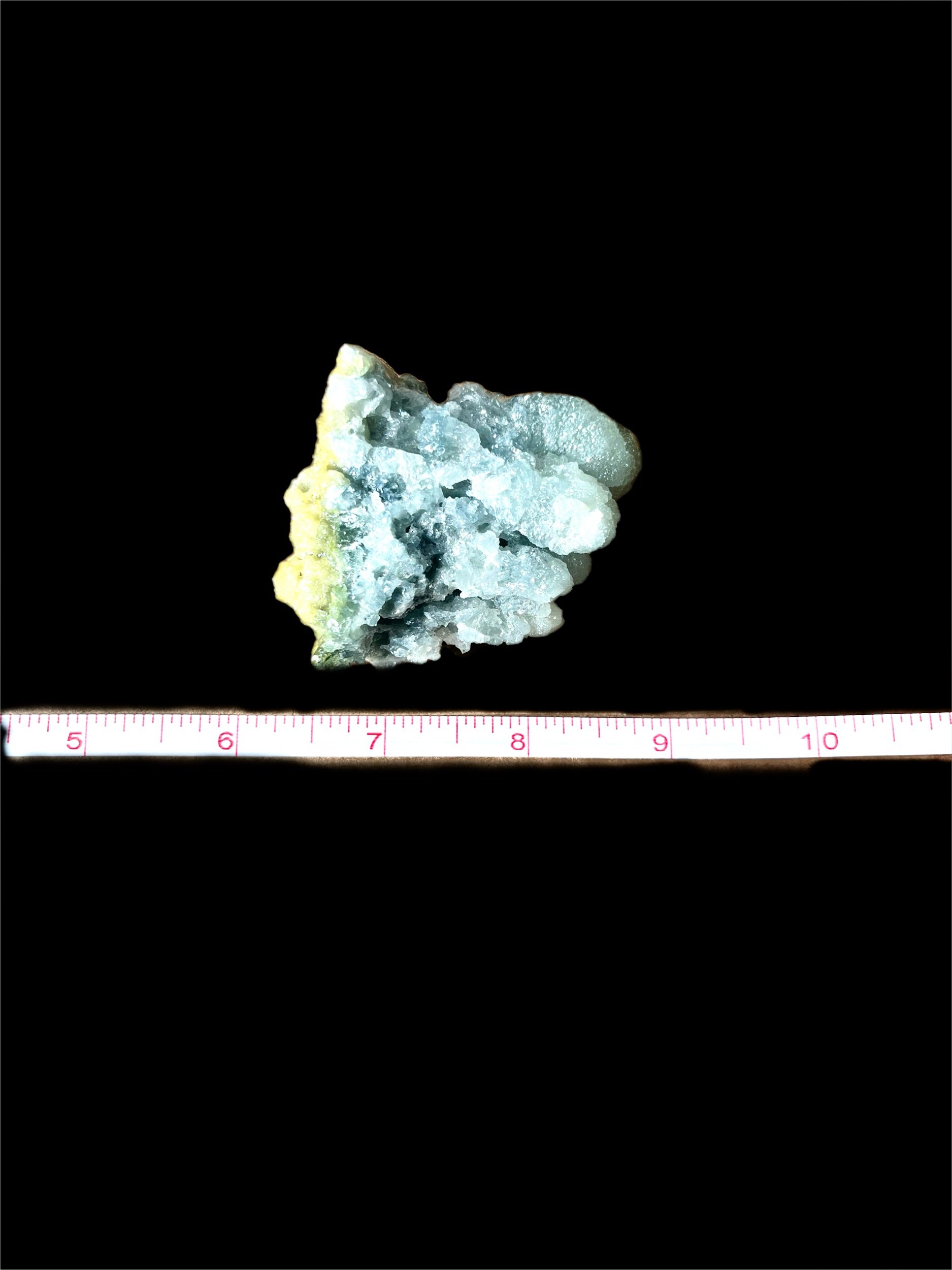
4” x 2.25” x 2”
519 grams
Collector’s Notes
This specimen illustrates a clear paragenetic sequence:
• Dioptase crystallization across matrix
• Calcite formation in a later phase
• Malachite growth partially enclosed within calcite
The malachite inclusion is particularly notable. Rather than simply sitting atop the surface, it developed during calcite formation and remains visibly suspended within the translucent crystal. This type of internal association adds mineralogical credibility and rarity.
Pieces that demonstrate sequential growth relationships tend to resonate with collectors who appreciate formation history as much as color.
Namibia has long produced some of the most desirable dioptase in the world, particularly from the Tsumeb region, where complex oxidation zones created ideal conditions for copper silicate crystallization.
Crystals of this caliber are more than acquisitions—they are heirloom-level treasures. This specimen is a world-class showpiece, ready to elevate even the most advanced collection.
The calcite appears to have formed in a later phase, settling gently across the dioptase field.
Pieces of this caliber are exceedingly scarce. Specimens of such integrity, with unblemished terminations and museum-quality presence, rarely appear on the private market.
This example offers not only exceptional visual appeal but also enduring value — the kind of mineral masterpiece that defines and elevates a serious connoisseur’s collection.
Highly recommended for the advanced collector focused on museum quality or investment-grade crystals.
While mineral collecting should always begin with personal appreciation rather than speculation, dioptase has remained one of the more consistently respected crystals in the fine mineral market. Pieces combining vivid color, defined crystal faces, high luster, and harmonious composition tend to retain desirability across collector generations.
For serious collectors, specimens like this represent not only an aesthetic centerpiece but also a tangible expression of geological rarity — the kind of piece that becomes a long-term anchor within an expertly curated collection.
Ships insured. Signature Required
Investment Consideration
Dioptase occupies a unique position in the mineral collecting world: visually dramatic, geologically rare, and consistently desirable among advanced collectors. Unlike minerals whose value is driven primarily by size or abundance, fine dioptase specimens are sought after for their crystal quality, saturation, and aesthetic composition — qualities that are increasingly difficult to source as classic deposits produce fewer top-tier pieces.
Examples that combine strong color, clean crystal structure, and visible paragenesis — such as malachite enclosed within calcite — occupy a more selective tier than single-mineral plates alone.
Several factors support long-term collector interest:
• Rarity of high-quality crystals — True collector-grade dioptase with strong color saturation, brilliant luster, and balanced matrix associations appear far less frequently on the market than lower-grade material. Top examples tend to be quickly absorbed into museums or elite private collections.
• Strong aesthetic demand — Dioptase’s vibrant copper-based green color makes it instantly recognizable, giving it crossover appeal between fine mineral collectors and design-focused buyers. Minerals with strong visual identity historically maintain stable demand even as trends shift.
• Multi-mineral complexity — Specimens featuring associated copper minerals (such as malachite and chrysocolla,) often command increased attention because they offer both visual contrast and mineralogical complexity, appealing to collectors seeking display pieces with scientific value.
• Limited replacement supply — Many historically significant copper localities that produced iconic dioptase are mature or declining, meaning exceptional new material enters the market in smaller quantities over time. This naturally reinforces scarcity among top examples, driving up their value.
This specimen is defined by coverage and and layered crystal growth. Its strength lies in visual complexity, mineralogical rarity, and locality credibility.
Dioptase remains a highly recognized collector mineral, but the market distinguishes clearly between small accent pieces and well-composed cabinet specimens.
While dioptase remains a recognizable species, pieces that show clear mineral relationships and maintain compositional balance tend to hold steadier collector interest over time.
Highlights
• Remarkable clarity and form
• Excellent color saturation
• High Luster
• Rare crystal type
• Rare Malachite inclusions
• Unique form
• Famous locality
Mineralogy
Dioptase (CuSiO₃·H₂O) forms in oxidized copper deposits and derives its intense green color from copper within its crystal structure.
Calcite (CaCO₃) often precipitates during later hydrothermal or secondary mineral phases. Malachite (Cu₂CO₃(OH)₂) is a secondary copper carbonate that commonly forms during oxidation of copper-rich environments.
The visible malachite within calcite indicates overlapping mineralizing fluids during crystallization, preserving a clear record of sequential growth.
Description
A compact and well-composed specimen featuring saturated emerald dioptase crystals accented by honey-toned calcite, with visible malachite included within portions of the calcite.
The dioptase forms a dense crystalline field across the matrix, its color deep and saturated. The crystals are sharply defined, catching light along their natural terminations.
Resting across this green surface is a sculptural cluster of calcite, softly translucent and warm in tone. Within sections of the calcite, fine green malachite growth is visible — suspended inside the crystal structure. These inclusions add depth and complexity, revealing the sequential nature of mineral formation.
The contrast between the angular dioptase and the rounded calcite creates balance, while the internal malachite detail invites closer inspection.
This is specimen is layered with mineralogical interest.
Dimensions & Weight
4” x 2.25” x 2”
519 grams
Collector’s Notes
This specimen illustrates a clear paragenetic sequence:
• Dioptase crystallization across matrix
• Calcite formation in a later phase
• Malachite growth partially enclosed within calcite
The malachite inclusion is particularly notable. Rather than simply sitting atop the surface, it developed during calcite formation and remains visibly suspended within the translucent crystal. This type of internal association adds mineralogical credibility and rarity.
Pieces that demonstrate sequential growth relationships tend to resonate with collectors who appreciate formation history as much as color.
Namibia has long produced some of the most desirable dioptase in the world, particularly from the Tsumeb region, where complex oxidation zones created ideal conditions for copper silicate crystallization.
Crystals of this caliber are more than acquisitions—they are heirloom-level treasures. This specimen is a world-class showpiece, ready to elevate even the most advanced collection.
The calcite appears to have formed in a later phase, settling gently across the dioptase field.
Pieces of this caliber are exceedingly scarce. Specimens of such integrity, with unblemished terminations and museum-quality presence, rarely appear on the private market.
This example offers not only exceptional visual appeal but also enduring value — the kind of mineral masterpiece that defines and elevates a serious connoisseur’s collection.
Highly recommended for the advanced collector focused on museum quality or investment-grade crystals.
While mineral collecting should always begin with personal appreciation rather than speculation, dioptase has remained one of the more consistently respected crystals in the fine mineral market. Pieces combining vivid color, defined crystal faces, high luster, and harmonious composition tend to retain desirability across collector generations.
For serious collectors, specimens like this represent not only an aesthetic centerpiece but also a tangible expression of geological rarity — the kind of piece that becomes a long-term anchor within an expertly curated collection.
Ships insured. Signature Required
Investment Consideration
Dioptase occupies a unique position in the mineral collecting world: visually dramatic, geologically rare, and consistently desirable among advanced collectors. Unlike minerals whose value is driven primarily by size or abundance, fine dioptase specimens are sought after for their crystal quality, saturation, and aesthetic composition — qualities that are increasingly difficult to source as classic deposits produce fewer top-tier pieces.
Examples that combine strong color, clean crystal structure, and visible paragenesis — such as malachite enclosed within calcite — occupy a more selective tier than single-mineral plates alone.
Several factors support long-term collector interest:
• Rarity of high-quality crystals — True collector-grade dioptase with strong color saturation, brilliant luster, and balanced matrix associations appear far less frequently on the market than lower-grade material. Top examples tend to be quickly absorbed into museums or elite private collections.
• Strong aesthetic demand — Dioptase’s vibrant copper-based green color makes it instantly recognizable, giving it crossover appeal between fine mineral collectors and design-focused buyers. Minerals with strong visual identity historically maintain stable demand even as trends shift.
• Multi-mineral complexity — Specimens featuring associated copper minerals (such as malachite and chrysocolla,) often command increased attention because they offer both visual contrast and mineralogical complexity, appealing to collectors seeking display pieces with scientific value.
• Limited replacement supply — Many historically significant copper localities that produced iconic dioptase are mature or declining, meaning exceptional new material enters the market in smaller quantities over time. This naturally reinforces scarcity among top examples, driving up their value.
This specimen is defined by coverage and and layered crystal growth. Its strength lies in visual complexity, mineralogical rarity, and locality credibility.
Dioptase remains a highly recognized collector mineral, but the market distinguishes clearly between small accent pieces and well-composed cabinet specimens.
While dioptase remains a recognizable species, pieces that show clear mineral relationships and maintain compositional balance tend to hold steadier collector interest over time.
Highlights
• Remarkable clarity and form
• Excellent color saturation
• High Luster
• Rare crystal type
• Rare Malachite inclusions
• Unique form
• Famous locality
Mineralogy
Dioptase (CuSiO₃·H₂O) forms in oxidized copper deposits and derives its intense green color from copper within its crystal structure.
Calcite (CaCO₃) often precipitates during later hydrothermal or secondary mineral phases. Malachite (Cu₂CO₃(OH)₂) is a secondary copper carbonate that commonly forms during oxidation of copper-rich environments.
The visible malachite within calcite indicates overlapping mineralizing fluids during crystallization, preserving a clear record of sequential growth.


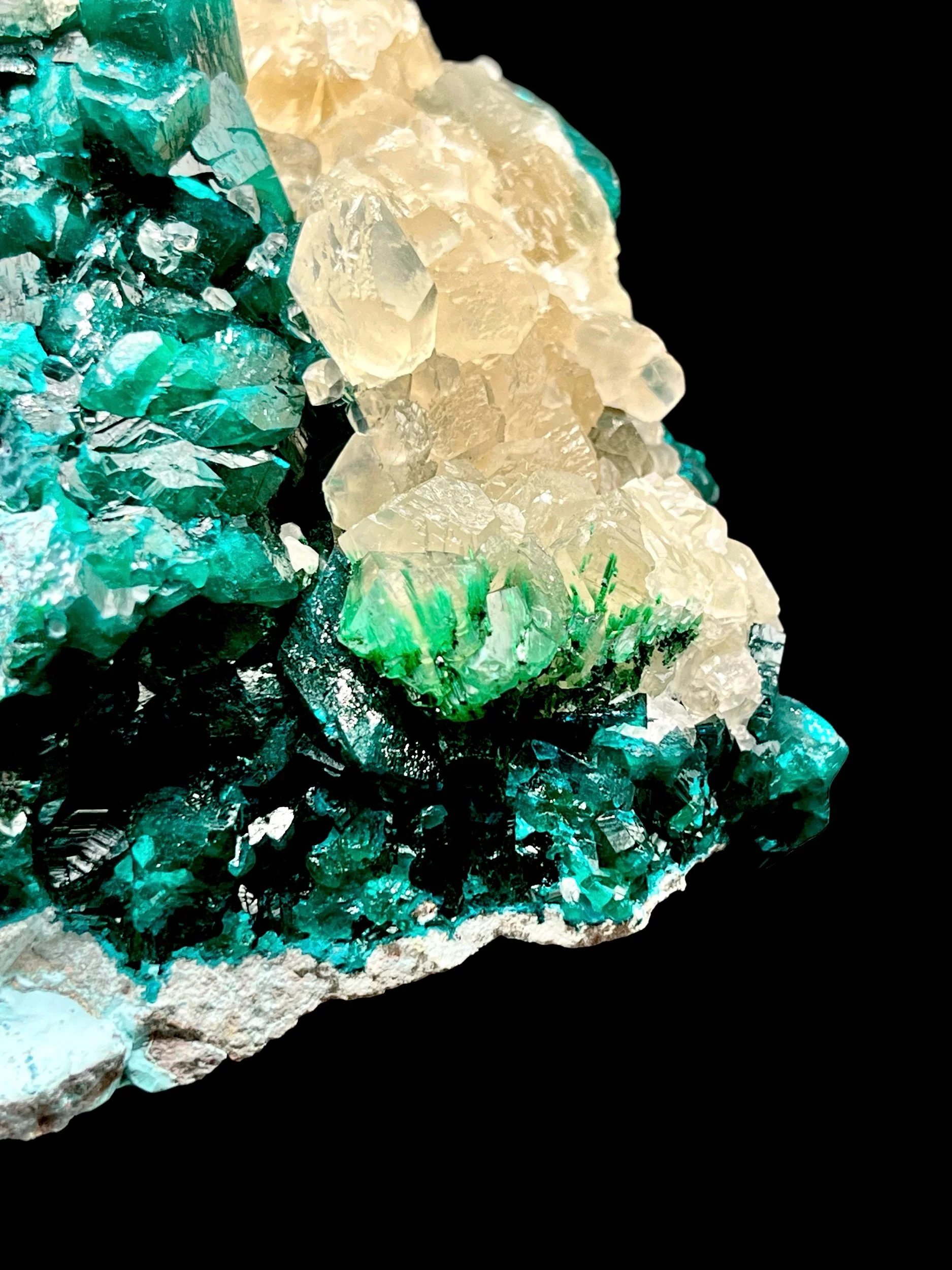 Image 1 of 6
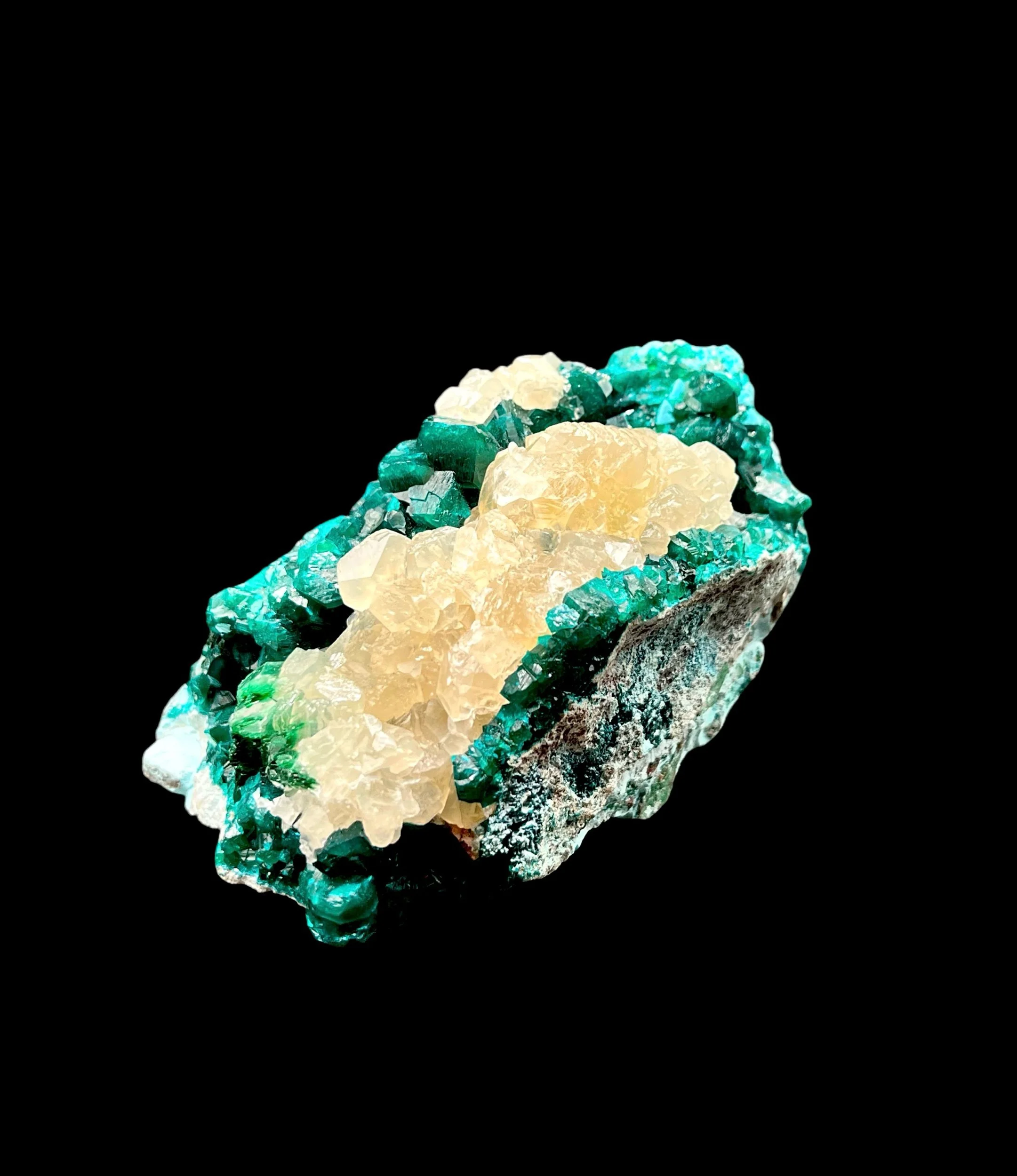 Image 2 of 6
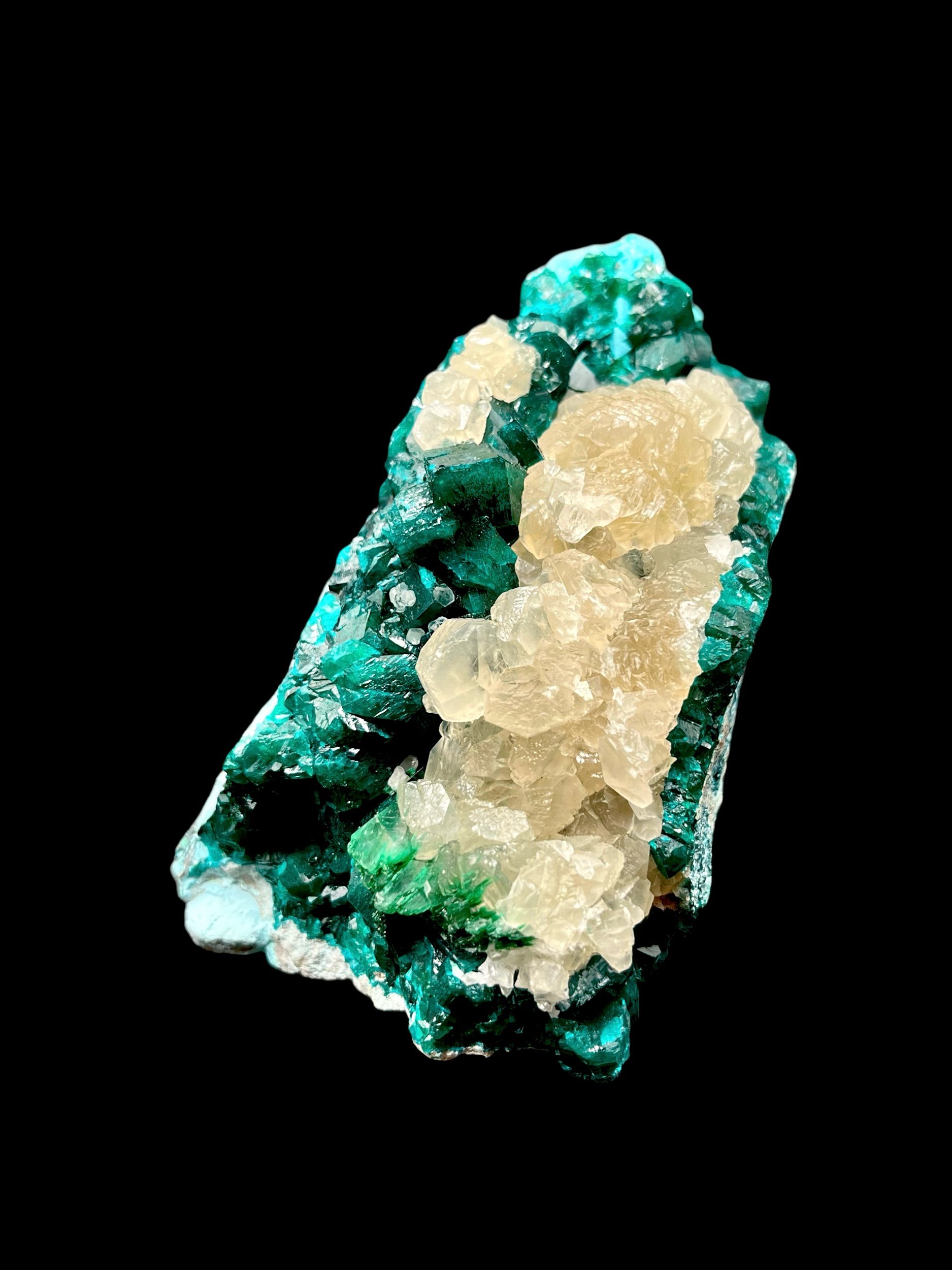 Image 3 of 6
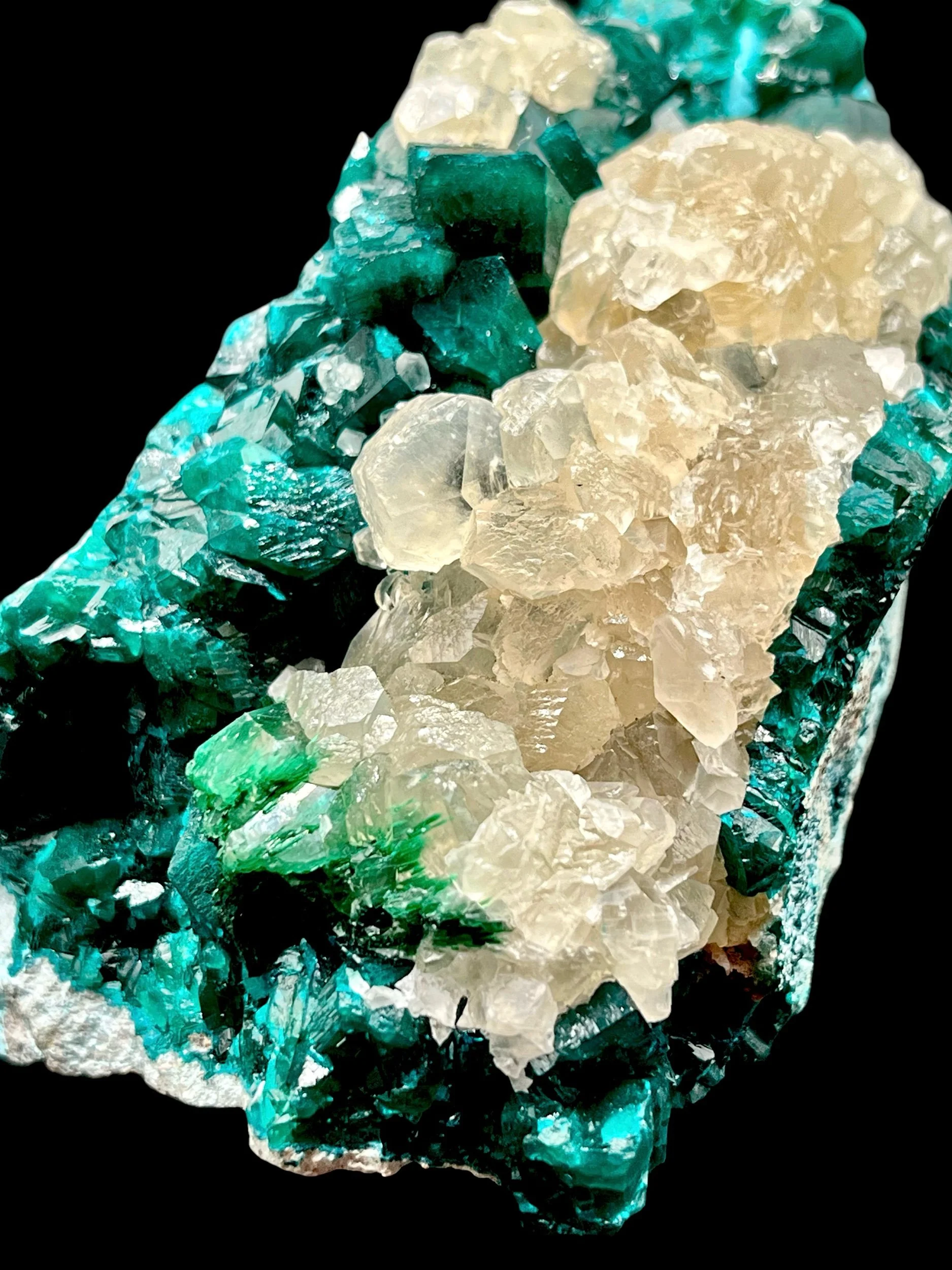 Image 4 of 6
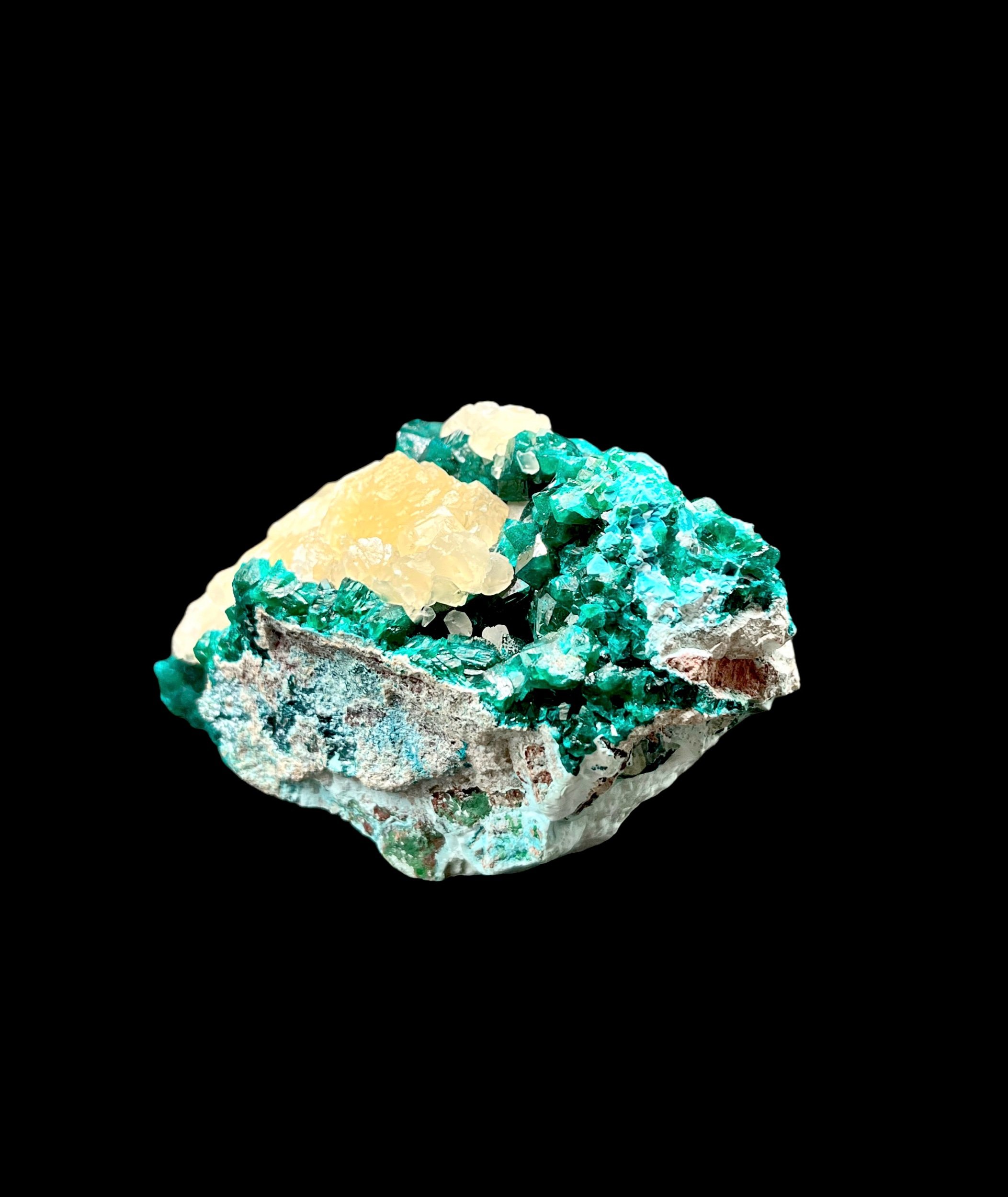 Image 5 of 6
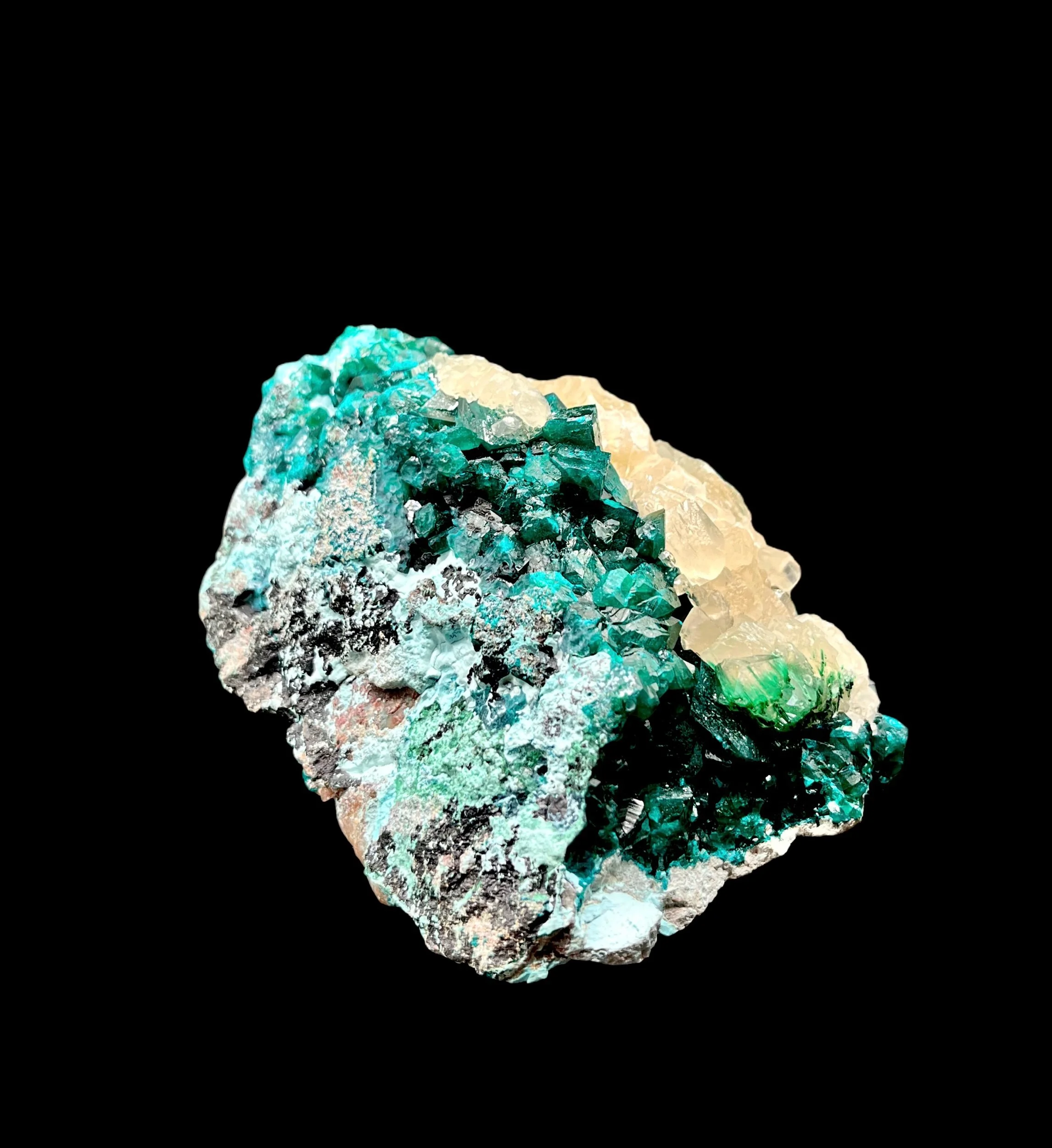 Image 6 of 6